
Understanding message queues
Did you know that, if you have a flow with multiple paths, data could be processed differently depending on the message queue configuration. In a flow, when data reaches an intersection and splits into multiple paths, the processing behaviour depends on whether message queues are enabled or not. This setting determines whether flow paths operate independently or follow a sequential processing order.
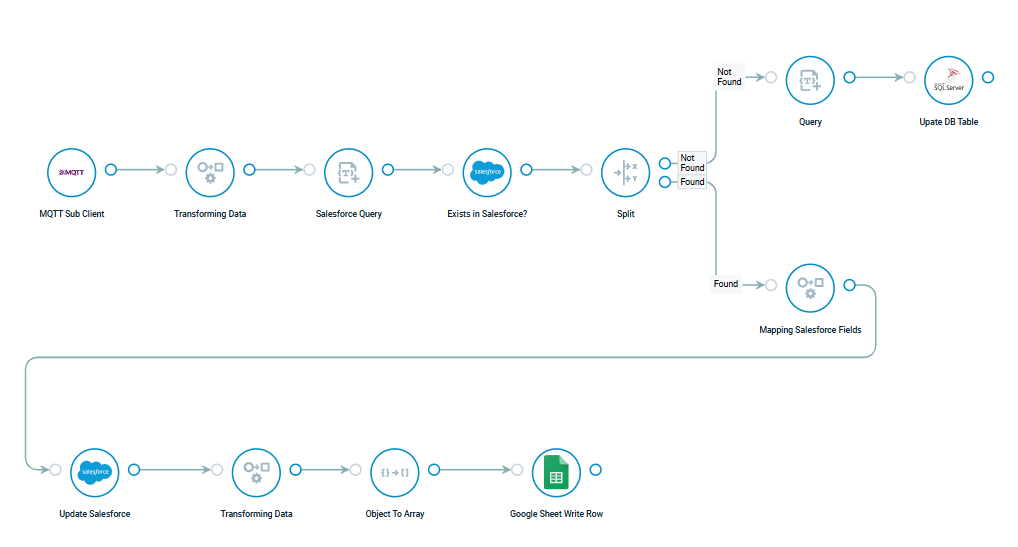
When queues are enabled, each flow path processes messages independently and in parallel. This means that processing in one path does not affect the processing in another. For example, in this flow one path writes data to a database while another path updates Salesforce records (via a native module), a failure to update a Salesforce record will not impact the database operation. Each flow path continues processing messages regardless of failures or dropped messages elsewhere in the flow.
When queues are disabled, flow paths are processed sequentially. Each path must complete its processing before the next path begins execution. Processing typically continues until a module sends data externally or paths are merged again. Even if a message is dropped in one flow path, it does not stop processing in the other path — it only changes the order of execution across the flow paths. This behavior is useful when strict processing order is required across multiple operations in a flow.
Here you can read more details about the message queues and retries.
Some related FAQs can be found here.
